
It is a late-night staple, a weeknight savior, and a universal crowd-pleaser. But while the quesadilla feels timeless, its creation was an act of accidental culinary brilliance a collision between ancient Mesoamerican grain traditions and European dairy.
Centuries before Spanish ships landed in Mexico, Indigenous peoples were perfecting nixtamalized corn. Aztec and Mayan cooks folded fresh, warm tortillas over native delicacies: squash blossoms (flor de calabaza), earthy huitlacoche, wild mushrooms, chilies, and spiced meats. These folded masa pockets were practical, portable, and nutrient-dense, but they were missing one key ingredient: cheese.
Pre-Hispanic Mexico had no dairy cows, sheep, or goats. That changed in the 16th century with the arrival of the Spanish, who introduced livestock and European cheese-making techniques. When local cooks tucked meltable string cheeses most famously the hand-pulled queso Oaxaca into hot corn tortillas over a blazing comal, the modern quesadilla was officially born.
The etymology is straightforward: queso (cheese) plus the Spanish diminutive suffix -illa, translating simply to “little cheesy thing.”
A popular internet myth claims the word derives from an ancient Nahuatl word like tlaxcalpocholli meaning “folded tortilla.” Linguists and food historians have debunked this completely – Nahuatl-speaking cultures had no indigenous dairy culture, meaning the linguistic root is 100% Spanish, even if the corn canvas was entirely Indigenous.
Order a quesadilla anywhere across North America or northern Mexico, and melted cheese is non-negotiable. Step up to a street stall in Mexico City (CDMX), however, and you are in for a surprise.
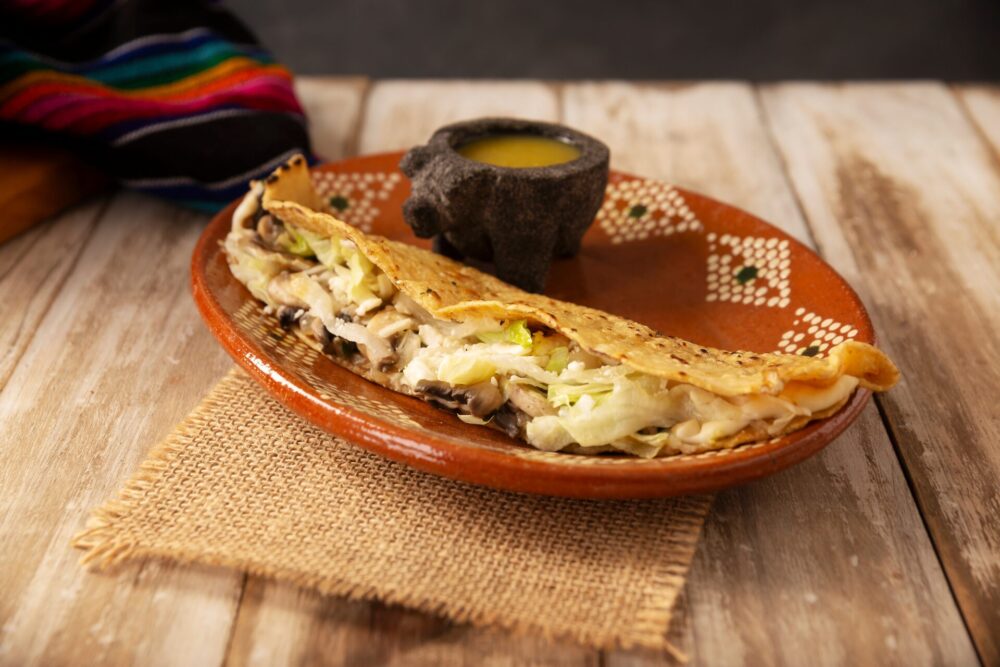
In the capital, a quesadilla refers to the form an oblong, folded masa pocket griddled or fried with fillings like tinga de pollo, chicharrón prensado, or sauteed mushrooms. If you actually want cheese melted inside, you must explicitly ask for it con queso. The quirk sparks endless, good-natured arguments between Chilangos and the rest of the country.